Food Trip in Northern Thailand: Why Every Cyclist Should Ride Hungry
There’s a specific kind of hunger that only comes from the saddle. It’s the earned, hollow feeling you get after hours of riding through mountain paddies: the moment you pull into a village and the smell of something grilling over charcoal hits you.
In northern Thailand, that moment happens all the time. And what's waiting on the other side of it is some of the most amazing food in Southeast Asia.
This is not the Thailand of pad thai and spring rolls. Chiang Mai, Chiang Rai, and the surrounding highlands belong to the ancient Lanna Kingdom, and the food still carries that identity: earthy, aromatic, shaped by Burmese, Yunnanese, and hill tribe influences. If you're planning a cycling tour holiday in northern Thailand, or simply trying to understand what a food trip here actually means, this is where to start.
The Signature Curry That Defines Northern Thailand
You will eat khao soi more than once for sure.

Northern Thailand's signature dish is a coconut curry broth served over soft egg noodles, topped with a tangle of crispy fried noodles and finished with pickled mustard greens, raw shallots, and lime on the side. It’s not as simple as you may think. The depth of the curry paste is built from dried spices, fresh chillies, and aromatics that vary from one cook to another. It gives each bowl a personality of its own.
The dish has Yunnanese Muslim origins: traders brought Burmese-style masala spices to Chiang Mai's markets somewhere around the late 1800s. Over time, locals added coconut milk to appeal to visitors who wanted something familiar. That one addition transformed it into something entirely new.
Order khao soi gai (chicken) for the classic version. The chicken arrives bone-in, slowly simmered until it nearly falls off on its own. Squeeze the lime, add the shallots, stir in a little of the pickled greens, and eat it while it's still hot enough. Most of the best shops only serve at lunch, and they close when the pot runs out. The rider who sets off early gets the better bowl!
In Chiang Rai, the version tends to run slightly creamier and sweeter, sometimes with extra turmeric deepening the colour to a vivid yellow. The soul of the dish is quite the same, but the character is different.
Morning Markets and the Rhythm of the Ride
One thing a cycling tour holiday gives you that a resort holiday does not necessarily, is that you are up early. And in northern Thailand, early is when the food is best.
Morning markets in Chiang Mai and Chiang Rai are busiest between 6 and 8am, before most tourists have even considered breakfast. This is when sai oua, the northern Thai herb sausage, packed with lemongrass, galangal, kaffir lime leaves, and curry paste, comes off the grill. In the morning, you get the version that crackles when you bite through the casing and releases fragrant smoke. Eat it with sticky rice, which you pull apart with your fingers and press into small balls to scoop up whatever else is on the table.
Sticky rice (khao niao) is the anchor of every northern Thai meal. It travels well in a small bag tucked into a jersey pocket, and more than one cyclist has discovered that it is also the perfect mid-ride fuel. It is slow-burning, filling, and sold at roadside stalls for almost nothing.
The cool season between November and February brings mountain-grown strawberries, fresh herbs, and crisp seasonal vegetables to the markets. It also coincides with the most comfortable conditions for a cycling itinerary in Thailand. The air is dry, the mornings are cool, and the temperatures make climbing feel earned.

Beyond Khao Soi: The Lanna Table
Northern Thai food is eaten communally, usually spread across a low table with several dishes. Here are the essential Lanna dishes to look for on your menu:
Kaeng hang le is a pork belly curry with Burmese roots, turmeric-stained, slow-cooked, faintly sour from tamarind, with ginger cutting through the richness. It has almost none of the heat that central Thai curries carry. If you are new to Thai food or simply riding hard enough that you don't want to eat anything too challenging, this is definitely to try.
Nam prik noom is a roasted green chilli dip, charred and pounded in a mortar with garlic and shallots. It arrives alongside raw vegetables and pork rinds for dipping. In this dish, the heat builds slowly, which is exactly what makes it “dangerous” for the palate.
Khanom jeen nam ngiao is rice noodles in a tangy, tomato-forward broth made from pork bones and dried spices. It is bold and complex, with a sourness that wakes you up better than any coffee!
Then there is the Khantoke. This is the traditional way of eating in the north. Dishes are served on a low teak tray and shared family-style, sometimes accompanied by folk music and dance. It is a ritual as much as a meal, and on a multi-day cycling tour through Chiang Mai or Chiang Rai, encountering it once changes the way you think of dinner.
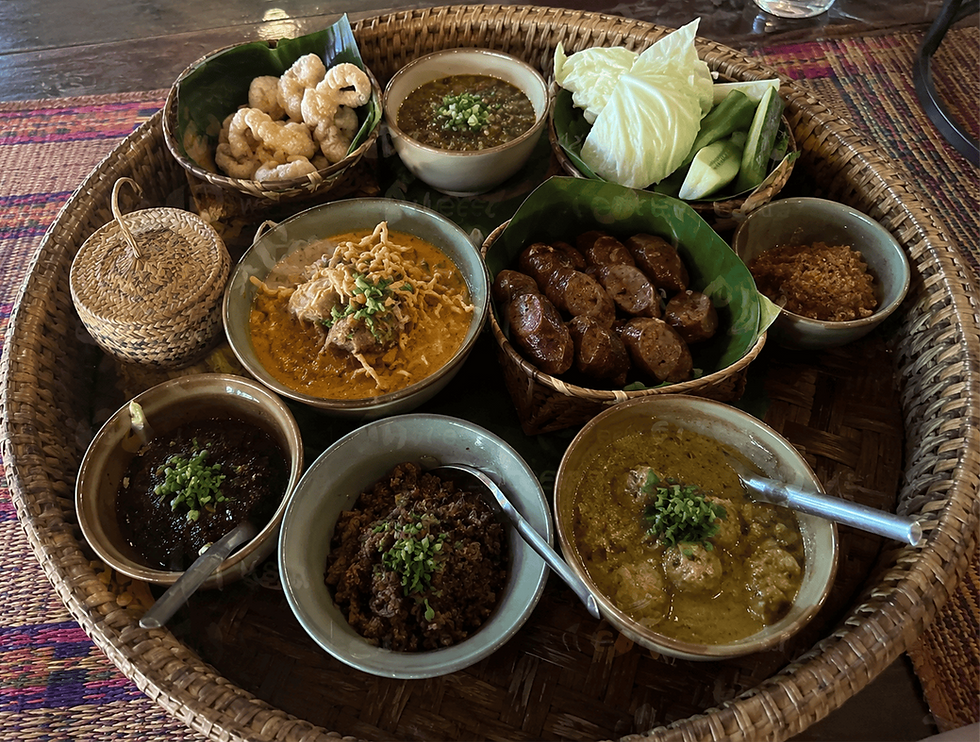
Chiang Rai's Layered Food Culture
Chiang Rai sits where Thailand, Myanmar, and Laos converge. This area is called the Golden Triangle, and the food reflects every layer of that geography. Kuomintang soldiers who retreated to the mountains after 1949 brought Yunnanese hand-pulled noodles and a tea culture that took root in Mae Salong. Hill tribe communities who were farming these highlands long before any national border existed still bring forest vegetables and wild herbs to the markets that nobody else in Thailand sells.
On a cycling tour by the Golden Triangle, you are moving through the evidence of all those intersections. Food is part of the same story.
When and Where to Eat
The rhythm of eating in northern Thailand aligns almost perfectly with the rhythm of cycling:
Dawn to 9am: Morning markets for sticky rice, grilled sai oua, and jok (rice porridge). This is the most local food experience you will have all day.
Late morning: Khao soi shops open for lunch service. The best spots fill up between 11am and 1pm and stop serving when the broth is gone.
Afternoon: Roadside stalls selling fresh fruit, sugarcane juice, and cold drinks. On a gravel bike tour through the northern highlands, these become essential checkpoints.
Evening: Night markets transform the same streets you rode through at sunrise into something different: lit up, fragrant, and full of choices. Chiang Rai's Night Bazaar runs until around 11pm, busiest between 7 and 9. Chiang Mai's Sunday Walking Street along Ratchadamnoen Road is harder to navigate but worth every slow step.
The cool season (November to February) is ideal for both cycling and eating. The produce is at its peak, the markets are stocked with fresh, seasonal, products, and the evenings are cool enough to sit outside without thinking about the heat.
The Real Point of a Food Trip by Bike
The honest reason that a cycling tour holiday makes you eat better than a regular holiday is that you are always somewhere new. Every lunch stop is a different village. Every morning market is a different selection. You are stopping at a place because something smelled good from the road, or because your route app flagged a local spot that nobody would ever find by themself.
That is what an immersive travel experience in Thailand actually feels like. You earn the food. And in the
north, the food is very much worth earning.

Ready to ride hungry through northern Thailand? Explore our cycling tours in Chiang Mai, Chiang Rai, and the Golden Triangle, self-guided or private, at your own pace.
FAQ
Is northern Thai food very spicy?
Northern Thai cuisine is generally milder than food from the south or northeast (Isaan). Khao soi, kaeng hang le, and many dips are approachable for people who find spicy food challenging. That said, nam prik noom and some larb preparations carry real heat. "Mai pet" (not spicy) is a useful phrase to know, though some dishes won't change much regardless.
Do I need to speak Thai to eat well in northern Thailand?
Not at all. Most market stalls and local restaurants operate on a point-and-smile system, and the food is usually visible, grilled, displayed, or served in pots you can look into. Learning a few words ("aroi mak" means delicious, and people light up when you say it) makes the experience more enjoyable, but it is not a requirement.
When is the best season to visit northern Thailand for food and cycling?
October to February is the sweet spot. The cool, dry weather makes cycling comfortable. Mornings are fresh enough for climbing, and the markets are stocked with seasonal highland produce like strawberries, fresh herbs, and mountain vegetables. The roads are at their most rideable, and the food is at its most varied.
Can I find vegetarian food in northern Thailand?
Yes. More easily than in many parts of Thailand. Buddhist "jay" (vegan) food is available at markets, most khao soi shops offer vegetarian versions, and Chiang Mai in particular has a strong café culture with meat-free options. The Lanna tradition of eating a wide variety of vegetables and herbs alongside meat means that even mixed dishes often have plant-forward elements worth ordering.
How does LocalRoutes integrate food into its cycling tours?
Our route apps include local food stops as points of interest, not tourist restaurants, but the places that we have actually tested and selected for their taste, their ambiance and location. On guided and private cycling tours, you will stop at morning markets, roadside stalls worth trying. Food is part of the itinerary on a LocalRoutes cycling holiday in northern Thailand.

